

Every event professional eventually runs the same calculation. You have rented the same piece four times this year, the invoice line has not changed, and you start wondering whether you should simply own it.
For most large rental categories the answer is no. For tabletop drink display, the answer is usually yes — and the trade publishes enough pricing data to work out roughly where the line sits. This guide does that arithmetic for planners and caterers, and covers how many drink stations a guest count actually needs.

The break-even rule the rental trade uses
Rental companies price inventory as a percentage of what it cost them, and those percentages are published. From Goodshuffle Pro and EventStable:
- Glassware, china, flatware: 30–40% of purchase price per rental
- Staging: 30–40%
- Dance floors: around 30%
- Tents: 20% (EventStable) to 20–25% (Goodshuffle Pro)
- Folding tables: 8–15%
- Resin folding chairs: around 10%
- Linens: 100–150%
Invert those and you get a rough break-even. A category renting at 10% of purchase price takes ten rentals to pay back. A category renting at 30–40% takes about three on the rate alone. LendControl gives a broader rule that builds in storage, transport and handling: "you should recoup your full investment within roughly 7-12 rentals, and everything after that is margin." Take 7–12 as the planning number.
Glassware sits at the expensive end of that scale for a specific reason — hand-cleaning labour and breakage. A drink display stand shares glassware's fragility profile and its visual role, but not its cleaning burden, which is what makes it an unusually good ownership candidate.
Which pieces to own and which to rent
QC Event Planning puts the principle plainly: buy the universal repeat items — "table runners, cloth napkins, sign holder, etc. You'll use them again and again, why not just purchase them?" — and rent the trendy pieces that complete one event's look.
The honest counterweight comes from the rental side. Borrowed Charm lists what ownership actually costs beyond the purchase: you must store bulky items, transport them, clean and maintain them, and eventually resell or dispose of them. Those are real expenses, and they are why owning a 7-foot champagne wall is a worse idea than it looks.
They are also why the tabletop format matters. A 19-inch stand that breaks down tool-free does not need climate-controlled storage or a truck. It stores flat rather than occupying rack space.
How many drink stations a guest count needs
Station count, not guest count, is what determines how many display pieces you need. From Culinary Eye:
- 100 guests: most receptions run 2–3 bartenders; a single bar is usually workable
- 150 guests: "a single bar rarely works well for a guest list this large" — splitting stations across the venue reduces waits
- 200 guests: two to four beverage stations depending on venue layout
Glass volume scales alongside it. Pedersen's rental guide gives a 100-guest, three-hour example running 180 wine glasses, 125 water goblets, 75 old fashioned and hi-ball, and 100 champagne flutes for toasts — with the scaling rule that "for each additional bar you have, increase the number of glasses by 50%."
In practice nobody stages 100 flutes at once. You stage a full, photogenic front display and refill behind it. At 12 glasses per stand, two to three stands per station is the working number:
- 100 guests, one station: 2–3 stands (24–36 glasses staged)
- 150 guests, two stations: 4–6 stands
- 200 guests, two to four stations: 4–12 stands
Trade pricing: 15% off 5 or more, 20% off 10 or more
KSESTOR applies trade pricing automatically. Order five or more units and 15% comes off at checkout; at ten or more it becomes 20%. There is no code to enter and no account to apply for. The discount is triggered by the quantity of units in the cart.
- 1–4 stands: $36.99 each
- 5 stands: $157.21 total (about $31.44 each), saving $27.74. Displays 60 glasses.
- 6 stands: $188.65 total (about $31.44 each), saving $33.29. Displays 72 glasses.
- 10 stands: $295.92 total (about $29.59 each), saving $73.98. Displays 120 glasses.
- 12 stands: $355.10 total (about $29.59 each), saving $88.78. Displays 144 glasses.
- 24 stands: $710.21 total (about $29.59 each), saving $177.55. Displays 288 glasses.
Unit figures are the effective per-stand price after the discount is applied to the order total. The same pricing applies across the KSESTOR Champagne Tower, Drip Tray, Drink Flight Board, Cocktail Flight Glasses and Beer Flight Glasses. Orders of $50 or more ship free within the US and stock ships in one business day.
Applying the trade's own 30–40% rental band to a stand at an effective $31.44 puts a rental rate at roughly $9.40–$12.60 per event. A six-stand kit at $188.65 covers a 150-guest wedding with two stations and, on the conservative 7–12 rental rule, pays for itself inside a normal season. A twelve-stand kit at $355.10 covers the largest events you are likely to take and lands in the deeper tier.
How caterers size display inventory
Caterers buy display in sets rather than singles, and the pattern is documented. PlinthsNY's catering guide describes a typical initial riser setup as "a 10 to 15-piece modular set," with a second set in a contrasting colour added as the operation grows. The same source puts commercial-grade acrylic riser lifespan at "used twice a week for 5 years," which it amortises to "under a dollar per event."
The buying pattern for drink display is the same, even if the lifespan of a metal piece is not directly comparable. You are not buying one stand for one wedding; you are buying a kit that covers the range of events you take, and reusing it across seasons. Note that a 10-to-15-piece set is also exactly where the deeper 20% tier begins.

Turnaround, storage and transport
Three practical points that decide whether an owned piece actually gets used.
Turnaround. LendControl puts minimum turnaround at "4-6 hours minimum between bookings for standard items like chairs and tables," and 12–24 hours for linens. Anything that has to be washed and dried is a scheduling constraint on a back-to-back weekend. In normal use the stand supports glasses by the stem and does not contact the drink, so it is a display piece rather than service ware. KSESTOR specifies hand cleaning only: wipe with a damp cloth, use mild soap and water if needed, and do not submerge it. It is ready as soon as it is wiped.
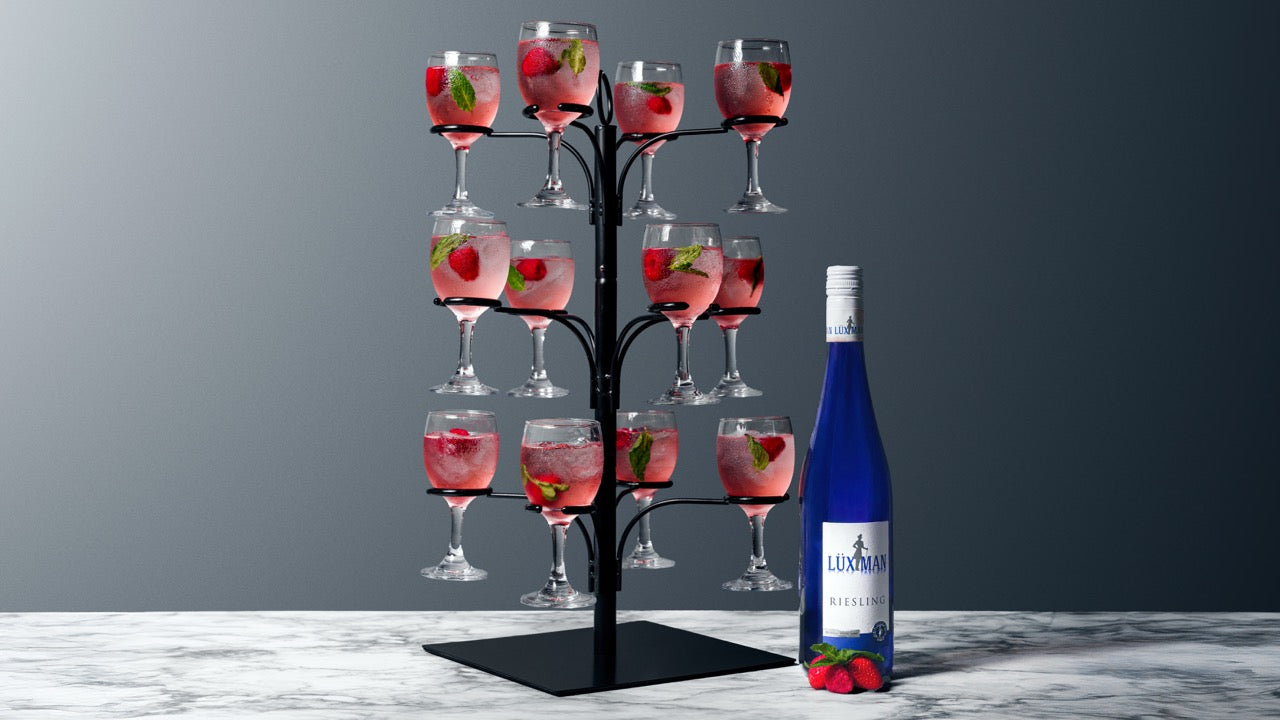
Storage. Assembled it is 9.05 inches square and 19 inches tall. It breaks down tool-free, so a multi-stand kit stores flat rather than occupying rack space.
Glass compatibility. This is the one to check before an event. The stand takes stemware up to 9 inches tall. You rarely control the glassware — the caterer or rental house supplies it — so confirm flute height in advance, particularly with a new rental supplier.
Specifications
- Tiers: 3
- Capacity: up to 12 glasses
- Maximum glass height: 9 inches
- Dimensions: 9.05" D x 9.05" W x 19" H
- Material: metal with welded branches
- Assembly: tool-free, screw-on
- Care: hand wash only — wipe with a damp cloth, mild soap and water if needed, do not submerge
- Warranty: lifetime warranty against defects in materials and workmanship under normal use
- Price: $36.99 per stand, about $31.44 at five or more, about $29.59 at ten or more
- Shipping: free on orders of $50 or more within the US; ships in 1 business day
Common questions
Should an event planner buy or rent drink display stands?
Buy, in most cases. Event rental pricing guidance puts glassware-class items at 30–40% of purchase price per rental, and the broader rule of thumb is full payback within 7–12 rentals. At an effective $31.44 per stand with trade pricing, a planner running a normal season of events recovers the cost well inside a year.
How many drink display stands do I need for 150 guests?
Four to six. A 150-guest event usually splits beverage service across more than one station, and two to three stands per station gives a full staged display of 48–72 glasses with room to refill behind it.
How many glasses does a cocktail tree stand hold?
Up to 12, in stemware up to 9 inches tall. Five stands display 60 glasses and twelve stands display 144.
Is there a bulk discount for event professionals?
Yes. KSESTOR applies 15% off automatically on orders of five or more units and 20% at ten or more, with no code and no application. The effective unit price drops from $36.99 to about $31.44, then to about $29.59. The same pricing applies across the Champagne Tower, Drip Tray and flight range.
How do you clean a drink display stand between events?
KSESTOR specifies hand cleaning only — wipe with a damp cloth, use mild soap and water if needed, and avoid submerging it. Because it supports glasses by the stem in normal use rather than contacting drinks, it does not need to go through a dish machine and does not sit in the turnaround queue behind glassware.
How much storage space does it take?
Each stand is 9.05 inches square and 19 inches tall assembled, and breaks down tool-free, so a multi-stand kit stores flat rather than occupying rack space.
Where the maths lands
Drink display is one of the few event categories where owning beats renting on almost any usage pattern. The rental trade's own pricing bands put payback in the low single digits on rate alone, and within 7–12 rentals once storage and handling are counted. Transport costs are near zero for a tabletop piece, and there is no washing labour to schedule around.
If you are building a kit for the season, six stands at $188.65 covers most of what you will take on, and twelve at $355.10 covers all of it at the better rate.
Featured blogs
- February 25, 2025
Discover essential tips for selecting the ideal cocktail tree stand. Enhance your gatherings with the perfect setup. Read the guide...
- August 08, 2024
If you’re looking to add some excitement to your next gathering, why not try a game where your guests guess...

- August 08, 2024
Date nights at home don’t have to be ordinary. In fact, with a little creativity and a cocktail flight board,...
- Choosing a selection results in a full page refresh.
- Opens in a new window.